| |
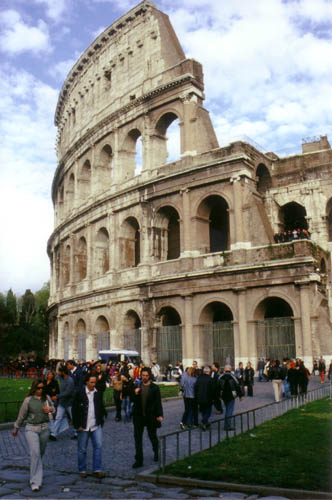
Started with
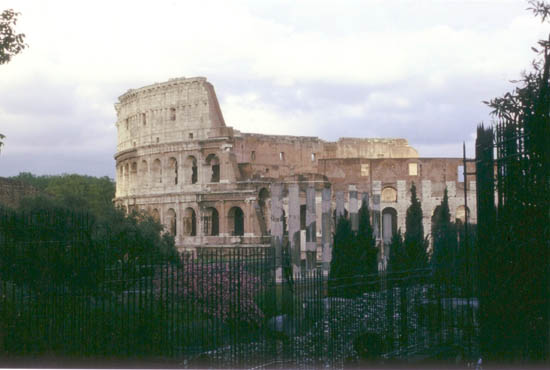
the Vespasien emperor into 70 after J.C., the Coloseum was finished by
his son Titus. The Coloseum drew its name from the Colossus, a giant
statue of Néron, disappeared today. In 80, the inauguration
lasts 100 days. During these continual festivities, some 9 000 wild
beasts are killed. Obviously, the many cats that you see there now do
not suspect all this violence.
|
|
| |
A great part of the history of
Coloseum is often ignored. In the Middle Ages, the arena was
transformed into castle, pertaining to the Frangipani family. After the
earthquakes, one installed a way of cross there: the building became
place of pélerinage to remember it the Christian martyrs who
would have perished there. This vision of the ancient history today is
disputed more and more by the historians: many think that the image of
Epinal of the Christians devoured by the lions, is false. Other
Christians were undoubtedly condemned to die in the arenas (damnatio AD
bestia), but as well as the criminals and other troublemakers of the
Empire. It is however thanks to this historical error that the Coliseum
arrived to us, in ruin certainly but upright.
In 1744, the pope Benoit XIV,
eager to preserve intact this image of the beginnings of Christendom,
made classify the monument, which made it possible to safeguard the
site. The true first restorations took place under Napoleon. The
external buttress that one sees at the end of the frontage still
upright was built by Valadier. And at the beginning of the
XVIIIème century, an architect named Fontana had the insane
project to transform the amphitheatre into a gigantic basilica, project
which remained in the paperboards. So that today the Coloseum allows us
to become aware of the disproportion of the plays of the amphitheatre
under the Empire: it is one of the sites most visited in the world.
|
|